
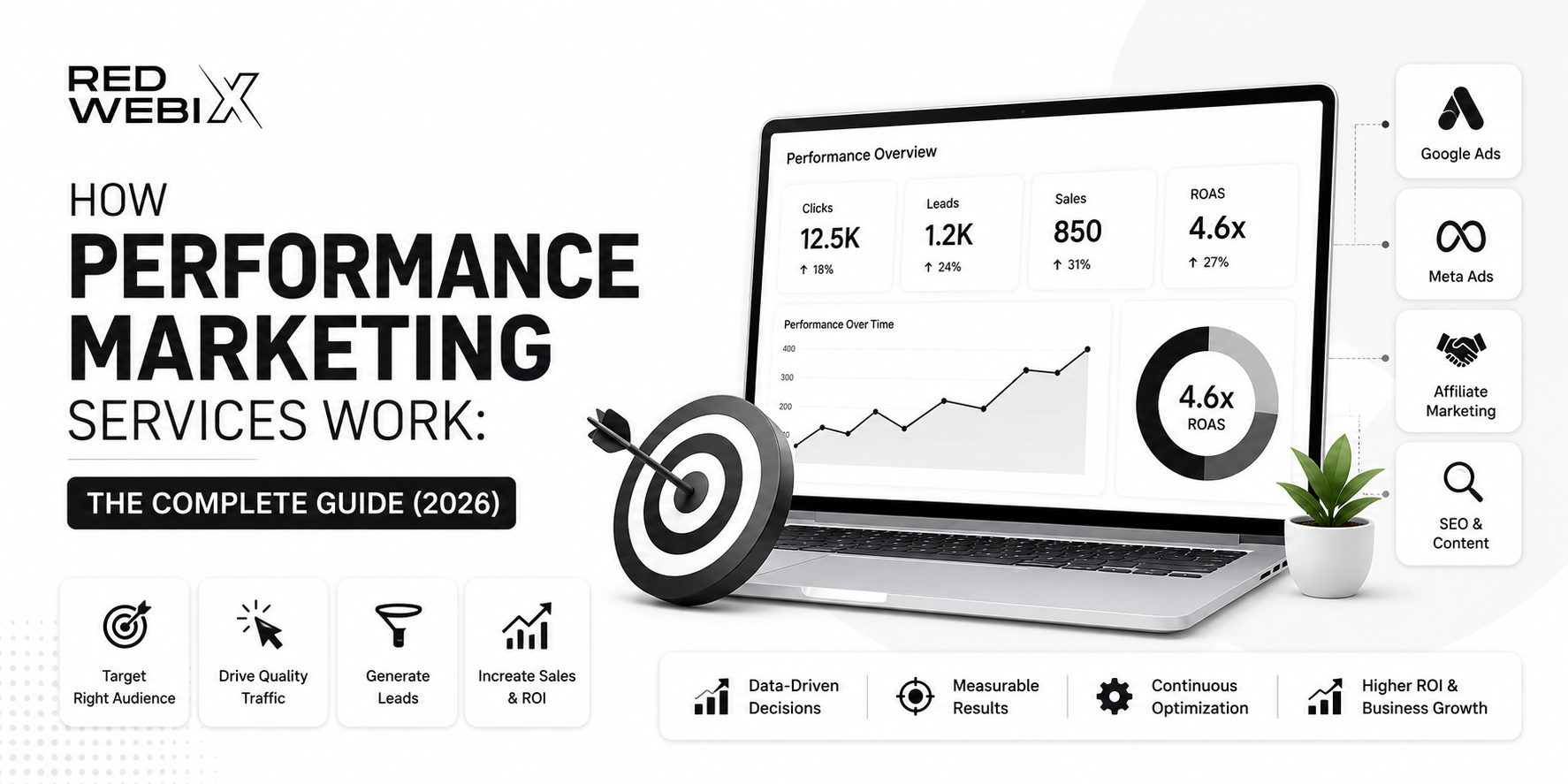
Performance marketing services are the digital marketing programs that charge you for results that you can measure, whether click, lead, sale, etc., but not for ad space, airtime, or impressions without results. These are paid channels such as PPC (Google Ads), paid social (Meta and Instagram Ads), affiliate marketing, and conversion-focused SEO, which are measured by cost per acquisition (CPA) and return on ad spend (ROAS).
That’s the short answer. Here’s what it actually looks like in practice, what it costs, when it works, and when it doesn’t.
What Is Performance Marketing?
Performance marketing is an advertising method that is based on data and where spending is only directed toward a specific action, not exposure. A billboard costs you money whether or not anyone purchases. Any money put into a performance marketing campaign is only considered a “win” if someone clicks on the link, fills out a form, downloads an App, or purchases something, and every dollar spent is attributable to that.
This is the fundamental gap between performance marketing and brand marketing – brand marketing is created over time and is difficult to measure directly, performance marketing is created to be measured directly, from the day it is created.
How Performance Marketing Works
A performance marketing campaign runs on three connected layers: tracking, targeting, and optimization.
Tracking comes first. Before a single ad runs, conversion tracking has to be set up correctly: pixel or tag implementation, UTM parameters, and a clean connection between the ad platform and your analytics (typically Google Analytics 4). Without this, “performance” marketing is just marketing with extra steps.
Targeting determines who sees the ad. Platforms let you target by demographics, interests, past behavior, and search intent, which is why performance marketing tends to outperform broad, undifferentiated advertising on cost per lead.
Optimization is ongoing. Campaigns are reviewed against their numbers on a regular cadence, weekly at minimum for active accounts, and budget shifts toward whatever is producing the lowest cost per acquisition and highest return on ad spend.
The channels performance marketing services typically cover
Paid search (PPC / Google Ads): Captures existing demand from people actively searching for a solution. Usually the highest-intent, fastest-to-measure channel.
Paid social (Meta Ads, Instagram Ads, LinkedIn Ads): Strong for audience targeting and creative-led demand generation, especially for e-commerce and B2C brands.
Affiliate and partner marketing: Third parties promote your product for a commission on results, which spreads risk and expands reach without upfront media spend.
Conversion-focused SEO and content: Organic traffic doesn’t carry a media cost per click, but it still gets measured against lead and revenue targets, which is why serious performance marketing programs pair paid channels with SEO services rather than running paid media in isolation.
Landing page and CRO work: Traffic without a landing page built to convert is wasted spend. This is often the highest-leverage, lowest-cost lever in the whole program.
The metrics that actually matter
Click-through rate and impressions tell you whether an ad gets attention. They don’t tell you whether it makes money. The metrics that determine whether a performance marketing program is working are:
Cost per acquisition (CPA): what you pay for each lead or sale
Return on ad spend (ROAS): revenue generated per dollar spent
Conversion rate: the percentage of visitors who complete the target action
Customer acquisition cost (CAC) relative to customer lifetime value (CLV): the number that ultimately decides if the whole program is profitable
Performance Marketing vs. Traditional Digital Marketing
| Factor | Performance Marketing | Traditional / Brand Marketing |
| Payment model | Pay for results (clicks, leads, sales) | Pay for placement or airtime regardless of outcome |
| Measurability | Fully trackable, real-time reporting | Difficult to attribute directly to revenue |
| Speed to results | Days to weeks | Months to years |
| Budget flexibility | Adjustable daily based on performance | Usually fixed for the campaign flight |
| Best for | Lead generation, e-commerce sales, app installs | Long-term brand recognition and trust |
| Risk profile | Lower, underperforming ads can be paused instantly | Higher, spend is committed upfront |
Neither approach replaces the other. Businesses with no brand recognition often need some brand-building alongside performance campaigns, because performance marketing converts existing demand more efficiently than it creates entirely new demand from scratch.
Why Your Business Needs Performance Marketing Services
Most businesses turn to performance marketing services after hitting one of three walls: their marketing spend isn’t tied to any measurable outcome, their in-house team lacks the bandwidth to manage multiple ad platforms properly, or their past campaigns produced clicks but not customers.
Benefits of performance marketing
Budget accountability. You can see exactly what each channel, campaign, and even ad creative is producing.
Faster feedback loops. Underperforming campaigns get identified and adjusted in days, not after a quarter has already closed.
Precise audience targeting. Ads reach people based on intent and behavior rather than broad demographic guesses.
Scalability. A campaign proven to work at a small budget can usually be scaled up while holding CPA relatively steady, up to a point.
Lower financial risk. Because spend is tied to results, wasted budget is easier to catch and stop early.
How Performance Marketing Services Help Businesses Grow
Growth from performance marketing typically happens in three stages, and understanding this sequence helps set realistic expectations.
Stage one: proof of concept (weeks 1–4). Campaigns launch with tracking in place. The goal isn’t scale yet; it’s collecting enough data to know which audiences, keywords, and creatives actually convert.
Stage two: optimization (weeks 4–12). Budget consolidates around what’s working. CPA typically drops during this stage as underperforming ad sets get cut and winning combinations get more spend.
Stage three: scale (month 3 onward). Once a channel is profitable at its current budget, spend increases in controlled increments while monitoring for rising CPA, a natural ceiling that shows up as an audience becomes saturated.
Businesses that skip stage one and jump straight to scale almost always overspend before they understand what’s actually converting.
Is Performance Marketing Worth It? Honest Pros, Cons, and Limits
It’s worth it when:
- You have a clear, trackable conversion action (a purchase, a form fill, a booked call)
- Your website or landing pages are functional and reasonably fast
- You can commit to at least 60–90 days before judging results
- Your average order value or customer lifetime value can absorb a reasonable acquisition cost
It’s not the right fit (or not yet) when:
- Your website has fundamental technical or trust issues; sending paid traffic to a broken funnel wastes the spend before the marketing strategy is even tested
- You need brand awareness in a market where almost nobody is searching for your category yet
- Your budget is too small to reach statistical significance within a reasonable testing window
A good agency will tell a prospective client honestly if performance marketing isn’t the priority yet. For instance, technical SEO issues may need fixing first so that paid traffic actually converts once it lands.
What Performance Marketing Services Cost
Pricing varies by agency size, industry competitiveness, and how the account is structured. The most common models:
Monthly retainer: Roughly $1,500–$10,000+/month for small-to-midsize businesses, covering management, optimization, and reporting.
Percentage of ad spend: Typically 10–20% of media budget as a management fee.
Performance-based: Pay per lead, or a percentage of revenue generated. This aligns the agency’s incentive directly with your results.
Project-based: A fixed fee for a defined campaign, such as a product launch.
On top of management fees, you’ll separately fund the actual ad spend paid to Google, Meta, or other platforms. That budget goes directly to the platform, not the agency.
A Step-by-Step Performance Marketing Process That Works
- Audit and goal-setting. Define the specific action being optimized for (a sale, a qualified lead) and audit existing tracking, website performance, and Core Web Vitals.
- Tracking setup. Implement conversion tracking, connect Google Analytics and Search Console, and confirm every conversion event fires correctly before spending a dollar on ads.
- Channel and audience selection. Choose the channels most likely to reach ready-to-convert audiences based on the product and sales cycle.
- Campaign build. Write ad copy, build creative, and set up landing pages designed specifically for the offer rather than just linked to the homepage.
- Launch with a testing budget. Start small enough to gather data without overexposing the budget to an unproven approach.
- Weekly optimization. Review CPA, ROAS, and conversion rate; pause underperformers, reallocate budget to winners.
- Scale deliberately. Increase budget on proven campaigns in controlled steps, watching for rising costs as audiences saturate.
- Report and reassess. Monthly reporting tied to business outcomes, not vanity metrics like impressions.
Common Mistakes Businesses Make With Performance Marketing
- Launching ads before tracking is verified, which makes every early decision a guess
- Judging results too early, since most channels need several weeks of data before patterns are reliable
- Sending paid traffic to an unoptimized landing page, which inflates CPA regardless of how good the targeting is
- Chasing clicks instead of conversions by optimizing for CTR when CPA and ROAS are the numbers that matter
- Ignoring the website’s technical health, since slow load times and poor Core Web Vitals quietly raise acquisition costs
- Spreading budget too thin across too many channels before any one of them has enough data to optimize
How to Choose the Right Performance Marketing Agency
Checklist:
- Can they show real, verifiable case studies with numbers, not just client logos?
- Do they explain their tracking and attribution setup clearly?
- Is their pricing model transparent, with ad spend separated from management fees?
- Do they combine paid media with conversion rate optimization and technical SEO, or only run ads?
- Will they tell you honestly if performance marketing isn’t your immediate priority?
- Do they provide regular, plain-language reporting, not just a dashboard link?
Where RedWebix Fits In
RedWebix builds performance marketing programs around measurable outcomes, not vanity metrics. That means conversion tracking is verified before a campaign launches, paid media is paired with PPC services and conversion-focused landing pages, and budget only scales once a channel proves it’s profitable. For businesses where paid traffic needs a stronger foundation first, RedWebix’s technical SEO and website design teams work alongside the paid media team so ad spend isn’t wasted on a funnel that isn’t ready.
Conclusion
Performance marketing services work because they remove guesswork from the equation: you set a measurable goal, track every dollar against it, and only scale what’s proven to convert. The businesses that get the most from it are the ones with solid tracking, a functional website, and realistic expectations for how long optimization takes.
RedWebix builds performance marketing programs the way this guide describes, tracking-first, conversion-focused, and honest about what needs to be fixed before ad spend scales. Contact RedWebix for expert digital marketing solutions, or get a free consultation and see what a measurable, accountable marketing program looks like for your business.
FAQ’s
Performance marketing is a digital advertising approach where businesses pay for specific, measurable actions, clicks, leads, or sales, rather than for ad exposure. It relies on tracking, audience targeting, and continuous optimization to tie spend directly to results.
It works through three connected layers: tracking (conversion measurement), targeting (reaching the right audience), and optimization (shifting budget toward what performs). Campaigns launch small, gather data, and scale once results are proven.
It gives businesses accountability for marketing spend. Instead of paying for exposure and hoping for results, every dollar is tied to a trackable outcome, which makes budgets easier to justify and optimize.
Key benefits include budget accountability, faster feedback on what’s working, precise audience targeting, scalability once a channel proves profitable, and lower financial risk compared to upfront, exposure-based advertising.
Neither replaces the other. Performance marketing is better for measurable, short-term outcomes like leads and sales. Traditional brand marketing is better for long-term awareness that performance channels alone can’t build.
Most agencies charge a monthly retainer ($1,500–$10,000+), a percentage of ad spend (10–20%), a performance-based fee per lead or sale, or a project fee. Ad spend paid to platforms like Google or Meta is separate from the management fee.
Yes, provided there’s a clear conversion action to track and a budget large enough to gather meaningful data within a testing window, typically at least a few hundred dollars a week to start seeing usable patterns.
Early signals usually appear within 2–4 weeks, but reliable optimization typically needs 60–90 days of consistent data before budget should scale significantly.
ROI varies by industry, offer, and execution quality, and is best measured through ROAS and CPA relative to customer lifetime value rather than a single universal benchmark.
The most frequent ones are launching before tracking is verified, judging results too early, sending traffic to unoptimized landing pages, and optimizing for clicks instead of conversions.
Common tools include Google Ads and Meta Ads Manager for campaign execution, Google Analytics 4 and Google Search Console for measurement, and landing page or CRO platforms for testing conversion improvements.