
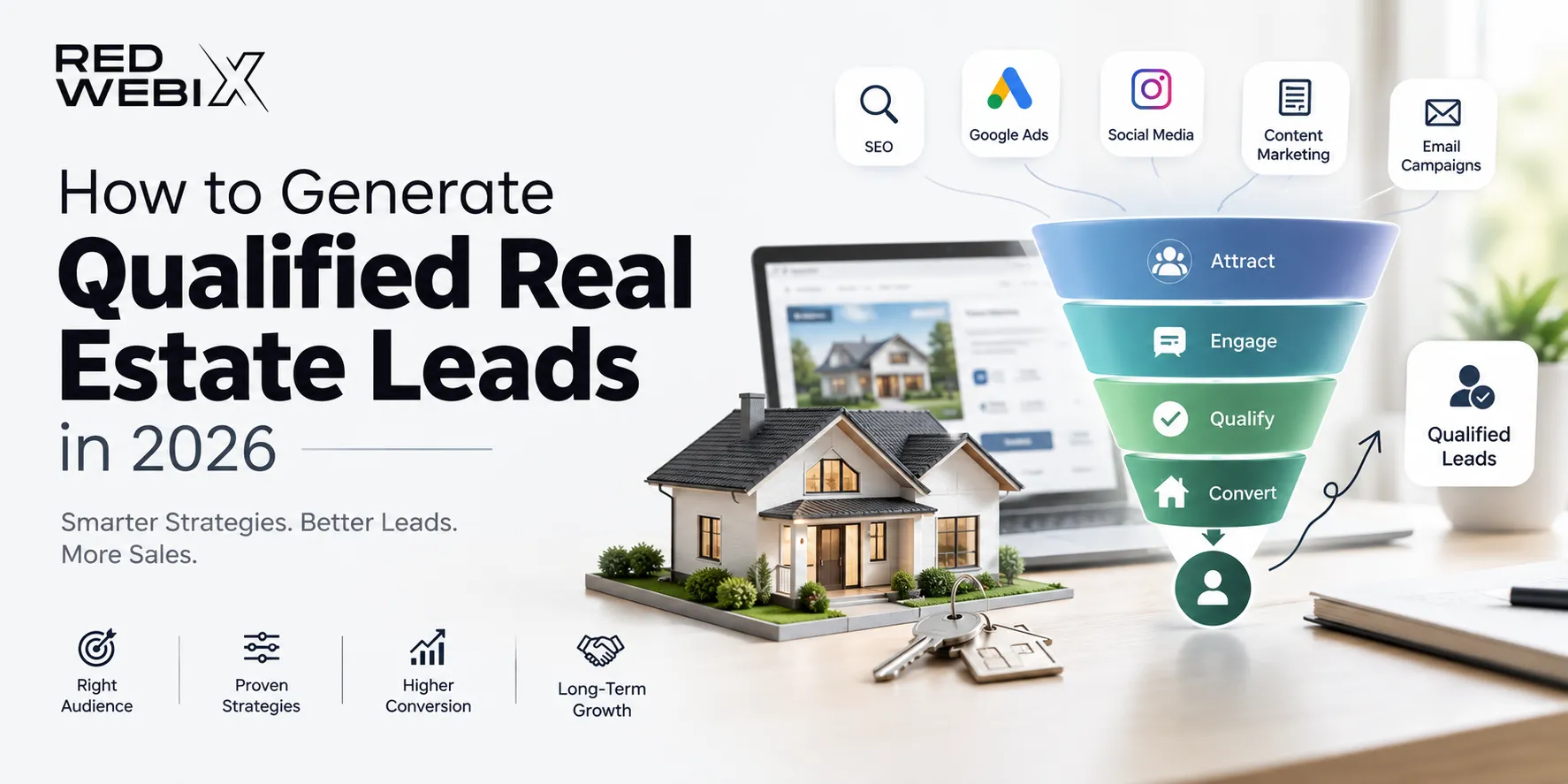
Real estate lead generation is the process of attracting potential property buyers and converting their interest into enquiries. In 2026, successful real estate marketing is not about generating the highest number of leads. It is about attracting qualified leads that match your property, location, budget, and buying intent. A strong strategy combines Google Ads, Meta Ads, SEO, landing pages, WhatsApp, retargeting, and CRM follow-up to turn online traffic into genuine sales opportunities.
What Is Qualified Real Estate Lead Generation?
A qualified real estate lead is a potential buyer who fits important criteria such as budget, preferred location, property type, and purchase timeline.
For example, someone asking for general property information may not be ready to buy. A prospect looking for a 3 BHK apartment within a specific budget and requesting a site visit is much more valuable to a sales team.
This is why real estate businesses should measure more than leads and cost per lead. Qualified leads, site visits, bookings, and revenue provide a clearer picture of marketing performance.
Why Real Estate Businesses Need Better Leads in 2026
Property purchases involve considerable research. Buyers often compare projects, locations, prices, amenities, developers, reviews, and financing options before contacting a business.
As a result, generating 500 enquiries does not necessarily mean a campaign is successful.
For example:
| Campaign | Leads | Qualified Leads | Site Visits |
| Campaign A | 200 | 20 | 6 |
| Campaign B | 100 | 35 | 15 |
Campaign B generates fewer leads but creates more meaningful sales opportunities.
The goal should therefore be better lead quality, not simply higher lead volume.
7 Effective Ways to Generate Qualified Real Estate Leads
1. Use Google Ads for High-Intent Searches
Google Ads can capture users who are actively searching for properties or real estate services.
Examples include:
- 2 BHK flats in Jaipur
- Flats for sale in Gurgaon
- Luxury apartments in Noida
- Commercial property in Pune
- New residential projects in Bangalore
Create campaigns around specific search intent and send users to relevant landing pages instead of a generic homepage.
Google also supports conversion goals for qualified and converted leads, allowing businesses to measure deeper stages of the sales funnel.
2. Generate Demand Through Meta Ads
Facebook and Instagram can help real estate businesses reach relevant audiences and showcase properties visually.
Effective formats include:
- Lead generation campaigns
- Click-to-WhatsApp ads
- Carousel ads
- Property videos
- Retargeting campaigns
- Project-launch campaigns
Use real property images, floor plans, amenities, location benefits, and walkthrough videos instead of generic promotional creatives.
Most importantly, don’t optimize only for the cheapest lead. A low-cost lead that never responds can be less valuable than a higher-cost lead that books a site visit.
3. Use SEO to Capture Organic Property Searches
Real estate SEO can attract buyers searching for specific properties, locations, and projects.
Instead of focusing only on broad terms such as “real estate,” target more specific searches:
- Flats for sale in Jaipur
- 2 BHK flats in Vaishali Nagar
- Commercial property in Gurgaon
- Luxury apartments in Bangalore
- Property investment in Noida
A strong strategy should include technical SEO, location pages, project pages, helpful content, internal linking, local SEO, optimized images, and conversion-focused landing pages.
The content should genuinely help potential buyers rather than simply repeating keywords.
4. Use WhatsApp to Reduce Conversion Friction
WhatsApp can make it easier for interested buyers to start a conversation.
Useful CTAs include:
Get Price & Floor Plan on WhatsApp
Book a Site Visit on WhatsApp
A simple funnel can be:
Ad → Landing Page → WhatsApp → Qualification → Follow-Up → Site Visit
The sales team should collect useful information such as budget, preferred configuration, location, project interest, and buying timeline.
5. Create Landing Pages for Specific Campaigns
A dedicated landing page can improve the relevance between an advertisement and the user’s requirement.
Include:
- Property or project name
- Location
- Property type
- Key features
- Amenities
- High-quality images
- Location benefits
- Relevant trust signals
- Contact options
- One clear primary CTA
Useful CTAs include:
- Book a Site Visit
- Get Project Details
- Request Price
- Get Floor Plan
- Check Availability
Avoid sending every paid campaign to your homepage. The landing page should match the search query and advertisement.
6. Use Retargeting for Interested Visitors
Most property visitors will not convert on their first visit.
A potential buyer may visit your website, compare another project, research pricing, and return several days later.
Retargeting can reconnect with people who:
- Visited a project page
- Viewed multiple pages
- Watched a property video
- Started but didn’t complete a form
- Engaged with social media content
The message should remain relevant to the user’s previous interaction rather than repeatedly showing the same generic advertisement.
7. Connect Marketing With CRM and Sales
Lead generation does not end when someone submits a form.
Your CRM should ideally track:
Lead → Contacted → Qualified → Site Visit → Negotiation → Booking
This helps identify which marketing channels generate actual business opportunities.
For example, if Google Ads produces 100 enquiries but only two site visits, while another campaign generates 50 enquiries and ten site visits, the second campaign may deserve more attention—even though it generated fewer leads.
What Makes a Real Estate Lead High Quality?
A qualified lead usually has several characteristics:
Relevant Property Requirement
The prospect is interested in the type of property you actually offer.
Suitable Budget
Their expected budget is reasonably aligned with the property’s price range.
Location Match
They are interested in your target location or project area.
Genuine Buying Intent
They are actively considering a purchase rather than simply browsing.
Realistic Timeline
They have a reasonable timeframe for making a decision.
These criteria should be customized to your property type and sales process.
Which Real Estate Lead Generation Metrics Matter?
Don’t measure your campaign only by CPL.
Track the complete funnel:
| Metric | Purpose |
| CTR | Measures ad engagement |
| CPC | Measures click cost |
| Conversion Rate | Measures visitor-to-lead performance |
| CPL | Measures lead acquisition cost |
| Qualified Lead Rate | Measures lead quality |
| Cost per Qualified Lead | Measures quality acquisition cost |
| Site Visit Rate | Measures sales progression |
| Booking Rate | Measures conversion into customers |
| CAC | Measures customer acquisition cost |
| ROAS/ROI | Measures financial performance |
For many real estate businesses, cost per qualified lead and cost per site visit can be more useful than CPL alone.
Common Real Estate Lead Generation Mistakes
Focusing Only on Cheap Leads
A low CPL does not guarantee good business results.
Sending All Traffic to the Homepage
Campaign-specific landing pages usually provide a clearer conversion path.
Ignoring Follow-Up
A good lead can become a lost opportunity if the sales team responds too late.
Measuring Only Form Submissions
Track what happens after the enquiry.
Not Tracking Offline Sales
If a digital lead eventually books a property offline, connect that outcome back to the original marketing source whenever possible.
Using Generic Content
Real estate buyers need specific information about properties, locations, pricing, amenities, connectivity, and availability.
How to Improve Real Estate Lead Quality
Step 1: Define Your Ideal Buyer
Identify the target location, budget, property type, buyer intent, and purchase timeline.
Step 2: Match Channels to Intent
Use Google Ads for high-intent searches, Meta Ads for demand generation and retargeting, and SEO for long-term organic visibility.
Step 3: Build Relevant Landing Pages
Match each landing page to the property, audience, and campaign.
Step 4: Track Meaningful Conversions
Measure qualified leads, site visits, bookings, and revenue—not just form submissions.
Step 5: Improve Sales Follow-Up
Create a clear process for contacting, qualifying, nurturing, and converting leads.
Step 6: Scale What Works
Increase investment in campaigns that consistently generate valuable opportunities rather than simply producing large lead numbers.
Is Real Estate Lead Generation Worth It?
Yes, when marketing and sales work together.
The real objective is not:
“How many leads did we generate?”
It is:
“How many qualified opportunities did our marketing create, and how many became customers?”
A successful real estate lead-generation strategy connects traffic, enquiries, qualification, follow-up, site visits, bookings, and revenue.
Frequently Asked Questions
How can I generate qualified real estate leads?
Use a combination of Google Ads, Meta Ads, SEO, relevant landing pages, WhatsApp, retargeting, and CRM-based follow-up. Define qualification criteria around budget, location, property requirement, and purchase timeline, then optimize campaigns based on qualified leads and sales outcomes.
Are Google Ads effective for real estate leads?
Yes. Google Ads can capture users actively searching for properties and real estate services. Performance depends on keyword targeting, landing-page relevance, conversion tracking, budget, and sales follow-up.
Are Facebook and Instagram good for real estate marketing?
Yes. Meta Ads can help real estate businesses showcase properties, generate enquiries, retarget website visitors, and reach relevant audiences. Campaigns should be evaluated based on lead quality and sales outcomes rather than CPL alone.
How do I reduce low-quality real estate leads?
Improve audience targeting, ad messaging, landing pages, qualification questions, and conversion tracking. Connect your CRM with marketing data and optimize toward qualified leads instead of treating every enquiry equally.
How long does real estate lead generation take?
Leads can start arriving soon after campaigns launch, but meaningful optimization requires enough data to understand audience quality, creative performance, conversion rates, and sales outcomes. The timeline varies by market, budget, property value, and sales cycle.
Final Takeaway
Real estate lead generation in 2026 is about generating better opportunities, not simply more enquiries.
Google Ads can capture high-intent buyers, Meta Ads can generate and nurture demand, SEO can build long-term visibility, WhatsApp can simplify communication, and CRM systems can connect marketing with sales.
The strongest strategy is:
Traffic → Lead → Qualified Lead → Follow-Up → Site Visit → Booking
RedWebix can help real estate businesses build a connected digital marketing strategy using SEO, performance marketing, website development, social media, and conversion-focused solutions.
Looking for better-quality real estate leads? Contact RedWebix to build a strategy around your property, location, audience, and business goals.
Want to improve your current lead-generation campaigns? Get a free consultation from RedWebix and identify where potential buyers are being lost.